A Free 50-Unit EA Exam Study Plan That Covers the Whole SEE Syllabus
How EA Dojo's free 50-unit study path breaks the 2026–2027 Enrolled Agent syllabus into units with lesson cards, mapped practice and a clear ready-to-move-on check, and how to use it as your study plan.

Last reviewed: November 10, 2026. Describes the study path live on eadojo.org on that date.
A good EA exam study plan answers one question every day: what should I study next? EA Dojo's free study path splits the 2026–2027 Special Enrollment Examination syllabus into 50 units across Parts 1, 2 and 3, and gives each unit the same Learn, Apply, Prove steps, so you always know what to do next.
The units follow the content areas the IRS publishes for the exam; see the IRS Enrolled Agent information page and the IRS Enrolled Agents FAQ.
How the study path is organized
| Part | Units | Focus |
|---|---|---|
| Part 1 | 18 | Individuals |
| Part 2 | 19 | Businesses |
| Part 3 | 13 | Representation, practices and procedures |
The study path page suggests starting at Part 1, Unit 1, with a diagnostic button beside it if you would rather test first.
What is inside each unit
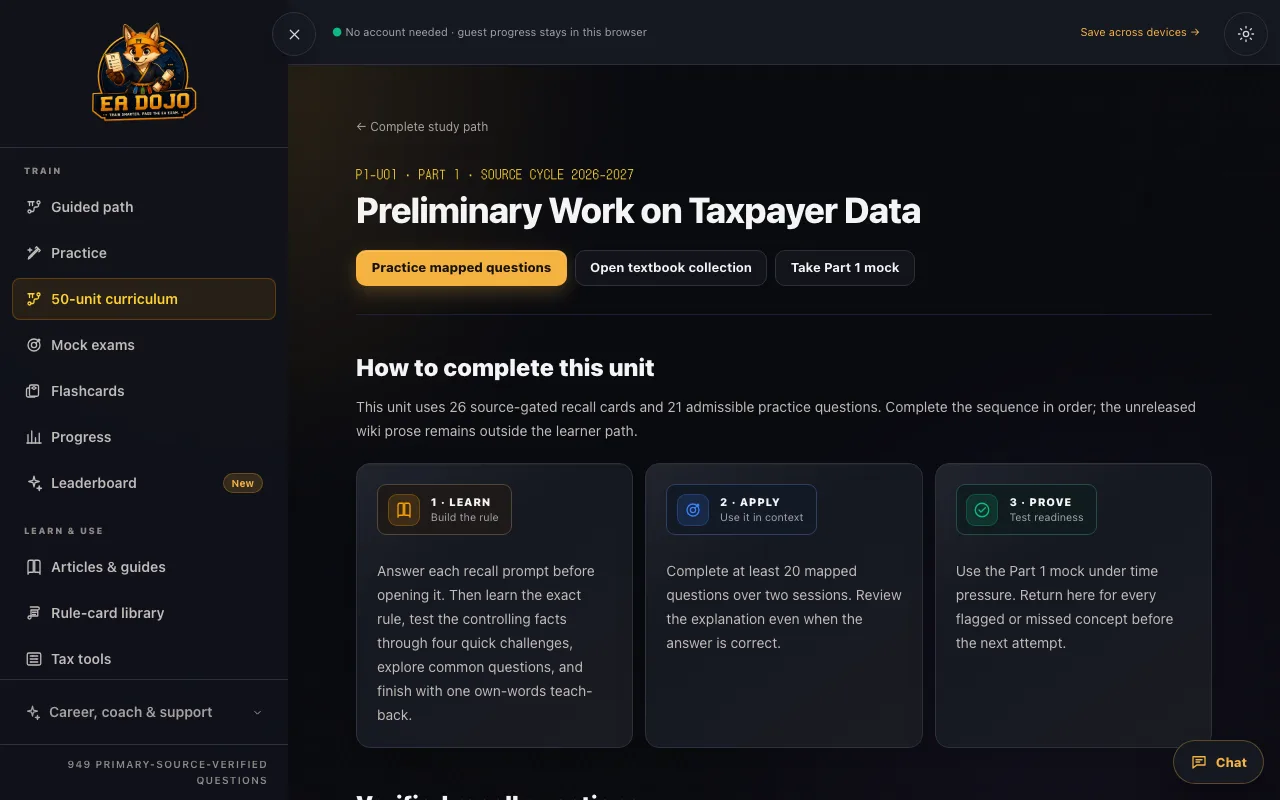
Each unit page shows the unit, its part and its source cycle, then three steps:
- Learn: read the unit's verified recall cards. Each card shows its source status and a short understanding check.
- Apply: practice the questions mapped to that unit, 10 at a time.
- Prove: check yourself against the unit's "ready to move on" criteria.
You can also jump to the unit's rule-card collection or the timed mock for that part. If a unit has no released lesson cards yet, the page says so rather than showing unchecked material.
When you are ready to move on
A unit is done when you can:
- explain 80% of its rules correctly on two different days;
- score 80% on its mapped questions (100% if it has fewer than 10);
- hold that level in a timed mock.
These checks help you pace yourself. They do not predict your PSI scaled score.
Why card-sized steps
So far, 10 people have tried every EA Dojo feature with us in person, and all 10 said they were satisfied with studying from a set of cards compared with their traditional study method. It is a small, informal group, not a study, but it matches why each unit is built from short cards you can finish in one sitting.
A sample weekly rhythm
- Monday to Thursday: one unit's Learn and Apply steps per day.
- Friday: flashcards on the week's units.
- Saturday: a mixed practice round and your progress page.
- Sunday: rest, or the Study Group for anything still unclear.